
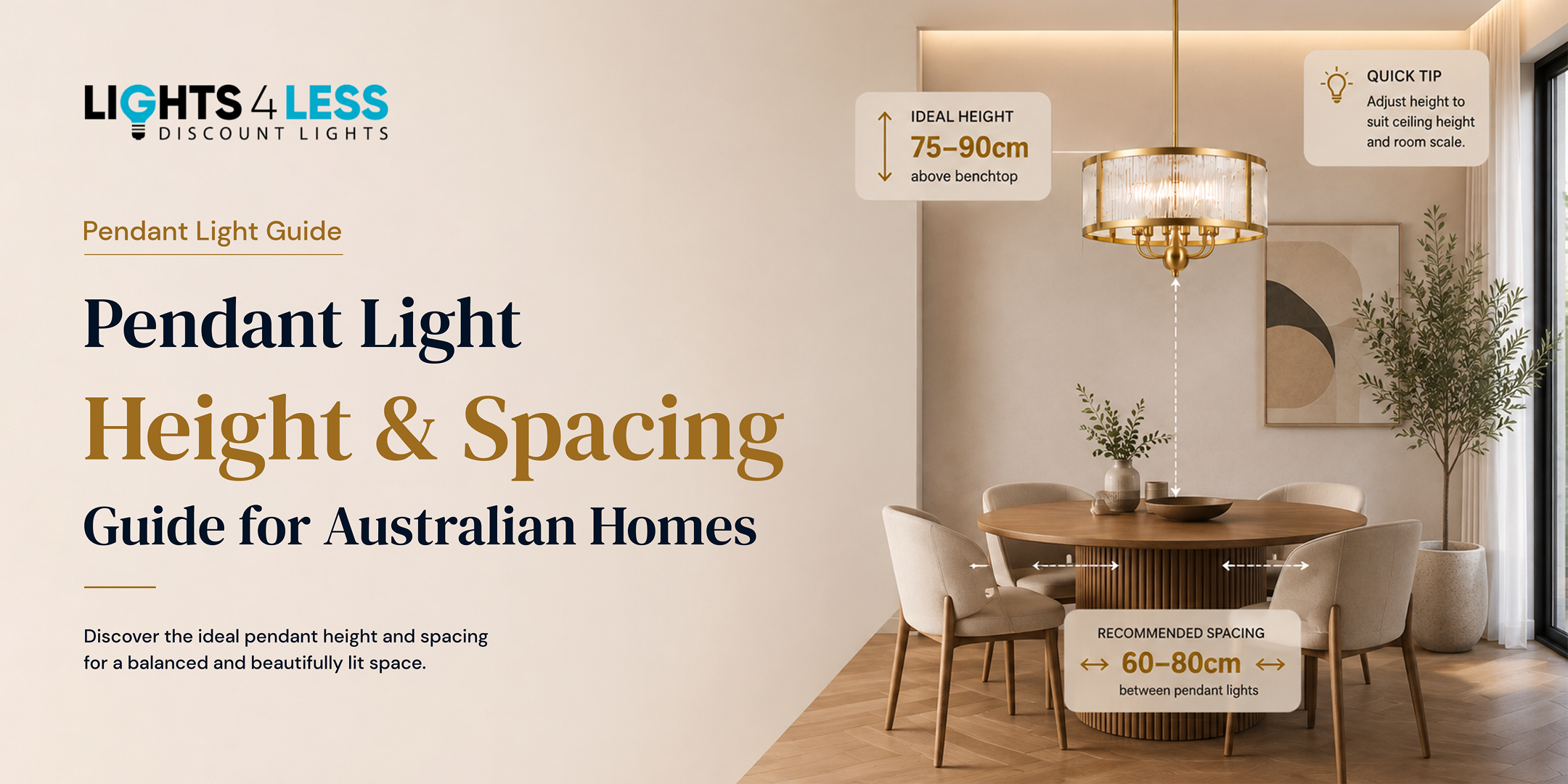
Getting the height and spacing right can make a big difference to how pendant lights look and function in an Australian home. A pendant that hangs too low can obstruct views or become impractical, while one that sits too high may lose its visual impact and provide less useful task lighting.
The right position depends on where the pendant is installed, the height of the ceiling, the size of the room, the furniture underneath it and whether you are using one fitting or several.
As a general starting point, pendant lights above a kitchen island are often positioned around 750–900 mm above the benchtop, while pendants above a dining table are commonly hung around 750–900 mm above the tabletop. These are useful starting points rather than fixed rules, so the final height should suit the room, fitting and people using the space.
This guide explains how to position pendant lights over kitchen islands, dining tables and other areas, including practical spacing guidelines and common mistakes to avoid.
Quick Pendant Light Height & Spacing Guide
|
Location |
Typical starting height |
Key spacing consideration |
|
Kitchen island |
750–900 mm above benchtop |
Keep even gaps between multiple pendants. |
|
Dining table |
750–900 mm above tabletop |
Centre the fitting or group over the table. |
|
Breakfast bar |
Around 750–900 mm above the benchtop |
Consider seating and sightlines. |
|
Entry or open area |
Depends on ceiling height and traffic |
Maintain comfortable head clearance. |
|
High ceiling |
Often requires a longer drop |
Consider room proportions and viewing angles. |
These measurements are starting points rather than strict rules. Pendant size, shade shape, ceiling height, furniture dimensions and the people using the space should all be considered before final installation.
What Is the Right Height for Pendant Lights?
There is no single height that works for every pendant light.
The ideal position should provide enough illumination while keeping the fitting visually connected to the furniture or area below it. It should also avoid creating an obstruction or blocking people's view across a table or kitchen island.
For many residential applications, a useful starting point is to measure from the surface below the pendant to the bottom of the light, rather than measuring from the ceiling.
For example:
-
Above a kitchen island: start around 750–900 mm above the benchtop
-
Above a dining table: start around 750–900 mm above the tabletop
-
Above a breakfast bar: start around 750–900 mm above the benchtop
-
In an open entry or living area: determine the height based on ceiling height, traffic flow and the size of the fitting
Always consider the pendant's overall dimensions and suspension length before deciding on the final position.
How High Should Pendant Lights Hang Above a Kitchen Island?
Kitchen islands are one of the most popular locations for pendant lights because they combine decorative lighting with useful task illumination.
A practical starting point is to position the bottom of the pendant approximately 750–900 mm above the kitchen island benchtop.
This range can provide a good balance between:
-
Useful task lighting
-
Comfortable sightlines
-
Visual impact
-
Protection from accidental contact
-
A balanced relationship between the pendant and island
For multiple pendant lights
If you are installing two or three pendants over a kitchen island, consistent spacing is just as important as height.
Start by finding the centre of the island and work outward. The pendants should generally be arranged symmetrically unless the room's design calls for an intentionally offset arrangement.
For a long island, a linear pendant or multiple evenly spaced fittings may work better than a single small pendant.
Consider the size of the island
A larger island can accommodate larger pendants or a greater number of fittings. A compact island may look crowded if several oversized pendants are installed.
The key is to balance the pendant size and spacing with the overall size of the island, rather than choosing each element separately.
How High Should a Pendant Light Hang Above a Dining Table?
Pendant lights above dining tables are usually positioned around 750–900 mm above the tabletop as a starting point.
This allows the pendant to create a defined lighting zone around the table without sitting so low that it interferes with conversation or people's line of sight.
The correct height can vary depending on:
-
Pendant diameter
-
Shade design
-
Table size
-
Ceiling height
-
Whether the pendant is open or enclosed
-
How tall the people using the room are
A large, low-profile pendant may need a different position from a narrow pendant with a deep shade.
Centre the pendant over the table
For a dining area, the pendant or group of pendants should generally be centred over the dining table rather than the room itself.
This is particularly important in open-plan Australian homes where the dining table may sit between the kitchen and living area.
The furniture should determine the lighting position.
How Far Apart Should Pendant Lights Be?
Spacing depends on the number and size of the pendants and the length of the surface below them.
For multiple pendants over a kitchen island, a useful starting point is to leave roughly 600–800 mm between the centres of smaller-to-medium pendants, then adjust according to the size of each fitting and the dimensions of the island.
For example, three small pendants over a long island can often be distributed evenly across the usable length rather than concentrated in the middle.
Avoid automatically using the same spacing for every fitting. A large pendant needs more visual breathing room than a small pendant.
A simple spacing method
-
Measure the length of the kitchen island or table.
-
Identify the centre point.
-
Decide how many pendants are appropriate for the surface.
-
Divide the available space evenly.
-
Check the distance from each pendant to the ends of the island or table.
-
Stand back and check the overall visual balance before finalising the position.
Symmetry is usually the safest approach when installing multiple matching pendants.
How Many Pendant Lights Should You Put Over a Kitchen Island?
The number of pendant lights depends primarily on the island's length, the size of the fittings and the desired visual effect.
One pendant
A single pendant can work well over:
-
Small kitchen islands
-
Compact breakfast bars
-
Small dining tables
-
Smaller preparation areas
A larger statement pendant can also be used when you want the fitting to become a central design feature.
Two pendants
Two pendants are a popular choice for medium-sized kitchen islands.
They can be positioned symmetrically around the centre of the island to provide balanced illumination and a clean appearance.
Three pendants
Three pendants can work particularly well over longer islands.
Rather than placing all three fittings close together, distribute them across the usable length of the island while maintaining consistent spacing.
Linear pendant
For a long island or dining table, a linear pendant can provide a more continuous visual arrangement than several individual fittings.
The best option depends on the dimensions and style of the room rather than a fixed number of lights.
Pendant Light Placement for Open-Plan Australian Homes
Open-plan kitchens, dining areas and living rooms are common in Australian homes. In these spaces, pendant lighting can help visually define different zones.
For example:
Kitchen: Pendant lights over the island can provide task lighting and establish the kitchen as a distinct zone.
Dining: A pendant above the dining table creates a focused lighting area.
Living: Downlights, floor lamps or wall lights can provide additional ambient and accent lighting.
This creates a layered lighting scheme instead of relying on one type of fitting throughout the entire open-plan space.
When choosing pendants for an open-plan room, consider how the fittings look from different viewpoints. A pendant that looks balanced from the kitchen may appear too low or visually heavy when viewed from the living room.
Pendant Light Height for High Ceilings
High ceilings give you more flexibility, but they can also make pendant placement more challenging.
Simply adding a longer suspension length does not always create the right result.
Consider:
-
The height of the ceiling
-
The size of the room
-
The size of the pendant
-
The furniture underneath it
-
Sightlines across the room
-
The visual weight of the fitting
A larger pendant or cluster can often work better in a room with a high ceiling because a very small fitting may look lost within the space.
For very high ceilings, the relationship between the pendant and the furniture below it is often more important than the distance from the ceiling.
How to Position Multiple Pendant Lights
When using several pendants, consistency is key.
Use even spacing
Matching pendants usually look best when they are evenly distributed.
Keep the same hanging height
Unless you are intentionally creating a staggered design, matching pendants should generally hang at the same height.
Centre the group
The group of lights should be centred over the island, table or other focal point.
Consider the viewing angle
Check the arrangement from:
-
The kitchen
-
Dining area
-
Living room
-
Main entrance
-
Nearby walkways
A pendant arrangement can look different depending on where you view it from.
Don't overcrowd the surface
More lights do not automatically mean better lighting.
Too many pendants can make a kitchen island or dining area look visually busy and can reduce the impact of each fitting.
Pendant Light Size and Height Should Work Together
Height should never be considered separately from pendant size.
A large pendant hanging at the wrong height can dominate a room, while a small pendant positioned too high may have little visual impact.
Think about the three dimensions together:
Width: How large is the fitting?
Height: How far is it from the surface below?
Spacing: How much room is there between multiple fittings?
For example, three large pendants require considerably more visual space than three small, narrow pendants.
Pendant Light Height for Different Ceiling Heights
Ceiling height can influence how a pendant feels in a room, but the furniture below usually provides the most useful reference point.
Standard-height ceilings
For a standard residential ceiling, choose a pendant size and suspension length that keeps the fitting visually connected to the furniture without creating an obstruction.
Higher ceilings
Higher ceilings allow more flexibility with longer suspension lengths and larger fittings.
However, avoid choosing an extremely long drop simply because the ceiling is high.
Very high or double-height spaces
Large spaces may require larger statement pendants, clusters or fittings specifically designed for high ceilings.
In these situations, consider the full vertical proportion of the room rather than applying a standard kitchen-island or dining-table measurement.
Common Pendant Light Placement Mistakes
Getting pendant lighting right is not only about knowing the recommended measurements. Avoiding common mistakes is equally important.
1. Hanging the pendant too low
A pendant that is too low can obstruct views, interfere with conversation and become impractical.
2. Hanging the pendant too high
A fitting that is too high may lose its relationship with the island or table and provide less effective task lighting.
3. Ignoring the size of the pendant
A large pendant needs more visual space than a small pendant.
4. Uneven spacing
Even small differences between matching pendants can make an arrangement look unbalanced.
5. Centring the light on the room instead of the furniture
In open-plan spaces, the dining table or kitchen island should usually determine the pendant's position.
6. Installing too many pendants
Too many fittings can create visual clutter and excessive brightness.
7. Forgetting sightlines
Always consider whether the pendant blocks people's view across the kitchen or dining table.
8. Choosing style before function
A pendant may look attractive but still be unsuitable if it does not provide the right amount or type of light for the area.

A Simple Pendant Light Placement Checklist
Before finalising your pendant light layout, check:
-
Surface: What will the pendant hang above?
-
Height: Is there enough clearance below the fitting?
-
Size: Does the pendant suit the size of the table or island?
-
Spacing: Are multiple fittings evenly distributed?
-
Sightlines: Can people comfortably see across the space?
-
Ceiling: Is the suspension length appropriate?
-
Lighting: Will the fitting provide the required illumination?
-
Style: Does it complement the room's existing finishes?
-
Safety: Will the installation be completed in accordance with applicable electrical requirements?
How to Choose Pendant Lights for the Right Space
Once you know the correct height and spacing, the next step is choosing a pendant that suits the room.
Consider:
Kitchen islands
Look for fittings that provide useful task illumination while complementing cabinetry, benchtops and appliances.
Dining rooms
Choose a pendant that creates a defined focal point above the table without dominating the space.
Entryways
A decorative pendant can make a strong first impression, particularly in homes with higher ceilings.
Bedrooms
Smaller pendants can be used as decorative alternatives to bedside lamps when appropriately positioned.
Open-plan spaces
Coordinate the pendant style with the surrounding lighting so the entire space feels visually connected.
Once you know the size and style you're looking for, consider how the pendant will work with the room's existing lighting and furniture.
Frequently Asked Questions
How high should pendant lights hang above a kitchen island?
A useful starting point is approximately 750–900 mm from the kitchen island benchtop to the bottom of the pendant. The final height should account for pendant size, ceiling height, sightlines and the people using the kitchen.
How high should a pendant light hang above a dining table?
A common starting range is approximately 750–900 mm above the tabletop. Adjust the height according to the pendant's size, shape, ceiling height and sightlines.
How far apart should pendant lights be over a kitchen island?
For smaller-to-medium fittings, around 600–800 mm between pendant centres can be a useful starting point. Larger fittings generally need more space, so always consider pendant diameter and island length.
Should pendant lights be centred over a kitchen island?
Generally, yes. A single pendant or group of pendants should usually be centred over the usable area of the island rather than simply centred in the room.
Should all pendant lights hang at the same height?
Matching pendants usually look most balanced when they hang at the same height. Different heights can work for a deliberately staggered design, but the arrangement should be planned rather than accidental.
How many pendant lights do I need over an island?
There is no universal number. The island's length, pendant size and desired lighting level all matter. One larger pendant may suit a compact island, while two or three smaller fittings may work better over a longer island.
Can pendant lights be too close together?
Yes. Pendants positioned too close together can make the installation look crowded and may create excessive overlapping light. Allow enough space for each fitting to have visual and functional impact.
Do I need a licensed electrician to install pendant lights?
For mains-powered lighting installation or changes to electrical wiring, use a licensed electrician and follow the applicable electrical requirements in your Australian state or territory.
Final Thoughts
The best pendant light height and spacing depends on the relationship between the fitting, the surface below it and the room around it.
As a starting point, 750–900 mm above a kitchen island or dining table is a useful range for many Australian homes. For multiple pendants, even spacing and careful centring can create a more balanced result.
However, measurements should always be treated as starting points rather than rigid rules. Pendant size, ceiling height, furniture dimensions, sightlines and the overall lighting plan all influence the final position.
Once you have determined the right height and spacing, choose a pendant that complements the room's proportions and lighting needs.
Explore the Lights4Less pendant light collection