
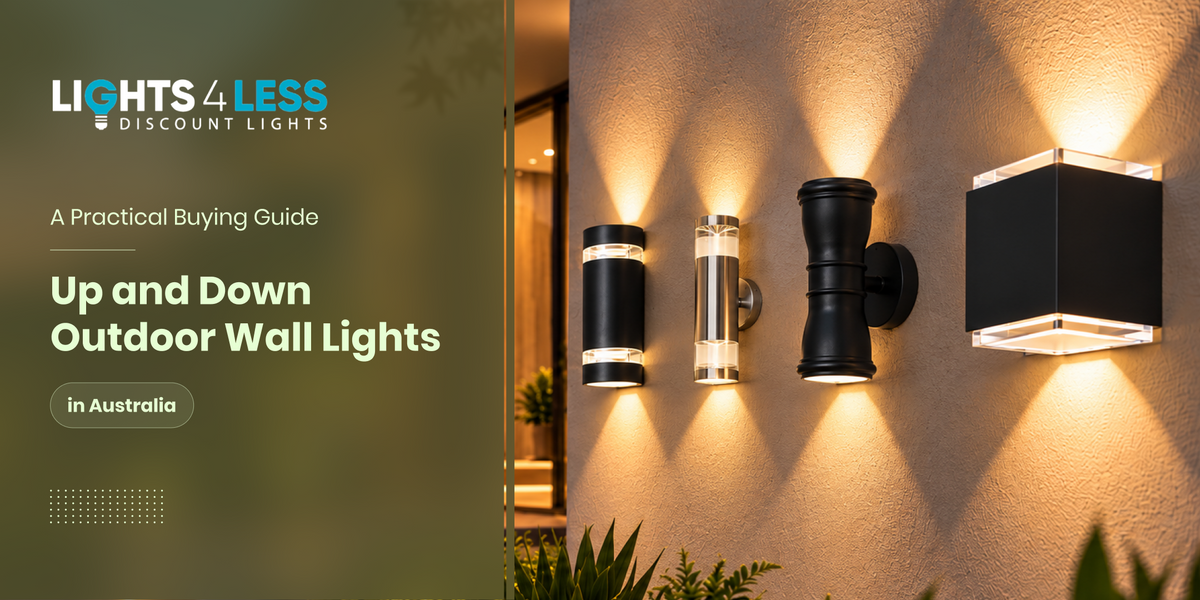
Up and down outdoor wall lights direct light upwards and downwards to create an architectural lighting effect on exterior walls. They can highlight entrances, garages, patios and feature walls while adding visual interest after dark.
The best fitting depends on your intended lighting effect, the amount of illumination required, the wall space available and the conditions where the light will be installed. Before buying, compare the IP rating, lumens, beam angle, colour temperature, dimensions, finish and installation requirements.
This guide explains what to look for and compares two Lights4Less options: the DENT Up & Down Wall Light in White Aluminium and the 3A Six-Light Exterior LED Wall Light in Black.
Which Up and Down Outdoor Wall Light Is Best for Your Home?
The right up and down wall light depends on how you want the exterior to look and how the space will be used.
-
For a decorative wall effect: Compare the beam angle, light distribution and fitting design.
-
For entrances and accessways: Check whether the light provides sufficient illumination for the area, rather than judging its performance by appearance alone.
-
For exposed outdoor locations: Check the product's IP rating, materials and manufacturer installation instructions.
-
For coordinated exterior lighting: Compare the finish, dimensions and colour temperature with nearby fittings and exterior materials.
-
For flexible light colour: Consider a model with selectable correlated colour temperature (CCT), and confirm which settings are available.
For example, the DENT Up & Down Wall Light offers selectable colour temperatures of 3000K, 4000K and 5000K, while the 3A Six-Light Exterior LED Wall Light offers 3000K, 4000K and 6500K, according to the listed product specifications. Compare these settings alongside light output, beam angle and installation requirements when choosing a fitting.
What Are Up and Down Outdoor Wall Lights?
Up and down wall lights are wall-mounted fittings that direct light towards both the upper and lower sections of a wall. Outdoors, they can create a distinctive pattern of light that highlights architectural features after dark.
Depending on their design and light distribution, they may suit:
-
Front entrances and house facades
-
Garage walls and side accessways
-
Covered patios and outdoor entertaining areas
-
Exterior feature walls
-
Courtyards and selected pathway areas
The result depends on the fitting's beam angle, light output, mounting position and the surface behind it. A narrower beam can create a more defined pattern, while a wider beam can spread light across a larger section of the wall.
Before choosing a fitting, decide whether your main priority is decorative lighting, practical illumination or a combination of both. A decorative wall effect does not automatically mean that the fitting will provide sufficient light for every entrance, step or pathway.
Choose an Outdoor Wall Light Style That Suits Your Home
The fitting's shape, finish and dimensions should work with the surrounding architecture. The right choice depends on the exterior materials, nearby fixtures and the visual effect you want to create.
Black Up and Down Wall Lights
Black fittings can create contrast against light-coloured render, brickwork and painted walls. They may also complement darker window frames, garage doors and other exterior details.
Before choosing a black fitting, compare its dimensions with the available wall space and nearby architectural features. A finish that looks appealing on its own may appear different once installed against the house facade.
White Up and Down Wall Lights
White fittings can blend into white or light-coloured exterior walls. They are worth considering when you want the light pattern to be more noticeable than the fitting itself.
The DENT Up & Down Wall Light in White Aluminium is one option to compare if you prefer a light-coloured finish.
Stainless Steel and Other Metal Finishes
Metal finishes can complement contemporary and minimalist exteriors. However, a silver-coloured appearance does not establish the exact material or its corrosion resistance.
For exposed locations, check the product's stated material, finish and manufacturer guidance. If the fitting will be installed in a coastal or corrosive environment, confirm that the manufacturer considers it suitable for those conditions.

Slimline and Geometric Designs
Rectangular, cylindrical and other geometric designs create different visual effects. Slimline fittings may complement clean architectural lines, while rounded designs can soften the appearance of an exterior wall.
Compare the product's actual dimensions and shape with the available mounting space rather than selecting a fitting on appearance alone.
Explore the Lights4Less Up / Down Wall Lights collection to compare available styles.
Where Should You Install Up and Down Outdoor Wall Lights?
The best location depends on the intended lighting effect and the practical needs of the space.
Front Entrances
Wall lights beside an entrance can highlight the doorway and create a welcoming appearance. Check the fitting's dimensions and proposed position against nearby doors, windows and architectural features.
If the light also needs to illuminate steps or an entrance path, assess its light distribution and the amount of illumination reaching the walking area. You may need an additional fitting designed for functional lighting.
Garage and Exterior Walls
Up and down wall lights can highlight a garage facade or exterior feature wall. The beam angle, light output and mounting position influence how the light spreads across the surface.
Check the manufacturer's installation instructions before deciding on the final position. If several fittings will be installed along the same wall, consider how their beam patterns will appear together.
Patios and Outdoor Entertaining Areas
For a covered patio, confirm that the selected fitting is suitable for the actual installation location and expected moisture exposure. Check the product's IP rating and manufacturer instructions rather than relying on the general label of outdoor wall light.
If the patio is used for dining, cooking or other tasks, consider whether separate task lighting is needed. Decorative wall lighting may not provide sufficient illumination for every activity.
Side Walls and Pathways
Wall-mounted fittings can help define side accessways and courtyard boundaries. However, the decorative effect on a wall is not the same as providing adequate visibility along a path.
Check where the light falls and whether it illuminates the walking area. A dedicated pathway light or another outdoor fitting may be needed, depending on the layout and intended use.
Check the IP Rating Before Buying
An IP rating describes the level of protection an electrical enclosure provides against the ingress of solid objects and water under defined test conditions. It is an important specification when choosing outdoor wall lights.
Not every fitting marketed for outdoor use is suitable for every exposed location.
Before buying, consider the following:
-
Covered outdoor areas: Check the manufacturer's stated suitability and installation instructions for the location.
-
Exposed exterior walls: Confirm that the product's rating and installation guidance suit the expected exposure.
-
Coastal or corrosive environments: Check the fitting's material, finish and manufacturer guidance for the specific environment.
-
Locations exposed to direct water: Do not assume that a product is suitable solely because it is described as an outdoor light.
The DENT Up & Down Wall Light in White is listed with an IP54 rating, while the 3A Six-Light Exterior LED Wall Light in Black is listed with an IP65 rating.
These ratings provide a useful starting point when comparing protection against water and solid-object ingress. However, an IP rating alone does not confirm that a fitting is suitable for every outdoor location. Check the manufacturer's instructions for permitted installation conditions, particularly if the fitting will be exposed to direct rain or other challenging weather conditions.
For the DENT, confirm that your intended location falls within the manufacturer's stated suitability for indoor or undercover outdoor use. For the 3A, check the manufacturer's installation guidance to confirm suitability for your specific outdoor exposure.
Choose the Right Colour Temperature
Colour temperature affects how the light appears and how the illuminated wall looks after dark. It is measured in kelvins (K).
Warm White
Warm white can create a softer appearance around entrances, patios and exterior feature walls. It may complement natural timber, warm brickwork and earthy exterior finishes.
Neutral White
Neutral white can provide a more balanced appearance when you want exterior details to remain relatively natural-looking. Consider how it will look alongside existing outdoor lights.
Cool or Daylight-Style White
Cooler white light can create a crisper appearance. However, it may look noticeably different from warmer lighting elsewhere on the property.
When several fittings illuminate the same facade, check that their available colour temperature settings can be matched if a consistent appearance is important.
The DENT model listed for this guide offers 3000K, 4000K and 5000K settings, while the 3A model offers 3000K, 4000K and 6500K settings. Confirm the available options on the exact product before purchasing.
Compare Brightness, Wattage and Beam Angle
Wattage indicates electrical power consumption, but it does not tell you everything about the amount of light a fitting produces or where that light will fall.
If you need practical illumination for an entrance, steps or an accessway, check the manufacturer's photometric information where available. Consider how much light reaches the area you need to illuminate, rather than judging performance by wattage or product photographs alone.
When comparing products, check these specifications:
| Specification | What It Tells You |
|---|---|
| Lumens | The amount of light emitted by the fitting. |
| Wattage | The electrical power rating. |
| Beam angle | How broadly the light is distributed. |
| Colour temperature | Whether the light appears warm, neutral or cool. |
| Dimmability | Whether the fitting supports dimming with compatible equipment. |
| Dimensions | How the fitting will fit on the wall. |
| IP rating | Protection against solid-object and water ingress. |
For decorative wall lighting, consider how the beam angle, fitting design and mounting position affect the pattern of light on the wall.
Compare Up and Down Wall Lights at Lights4Less
The DENT has a higher stated light output and a wider beam angle, while the 3A has a higher IP rating. These figures can help you narrow your options, but they do not independently establish which fitting will perform better in your space. Consider the desired wall-lighting effect, the manufacturer's permitted installation conditions and the position of the fitting before making your choice.
| Feature | DENT White Aluminium | 3A Black Six-Light |
|---|---|---|
| Wattage | 2 × 6W | 6 × 1W |
| Light output | 810 / 860 / 910 lm | 500 lm |
| Colour temperature | 3000K / 4000K / 5000K | 3000K / 4000K / 6500K |
| Beam angle | 81° | 64° |
| IP rating | IP54 | IP65 |
| Dimensions | 142 × 230 × 41 mm | 170 × 80 × 41 mm |
| Dimmable | No | No |
DENT Up & Down Wall Light — White Aluminium
The DENT Up & Down Wall Light in White Aluminium is an option to consider if you prefer a white exterior fitting with selectable colour temperature settings of 3000K, 4000K and 5000K.
Its listed specifications include a light output of 810, 860 or 910 lumens, an 81° beam angle and dimensions of 142 × 230 × 41 mm. Check these details against your intended lighting effect and available wall space. Its IP54 rating and the manufacturer's permitted installation conditions should also be considered before purchasing.
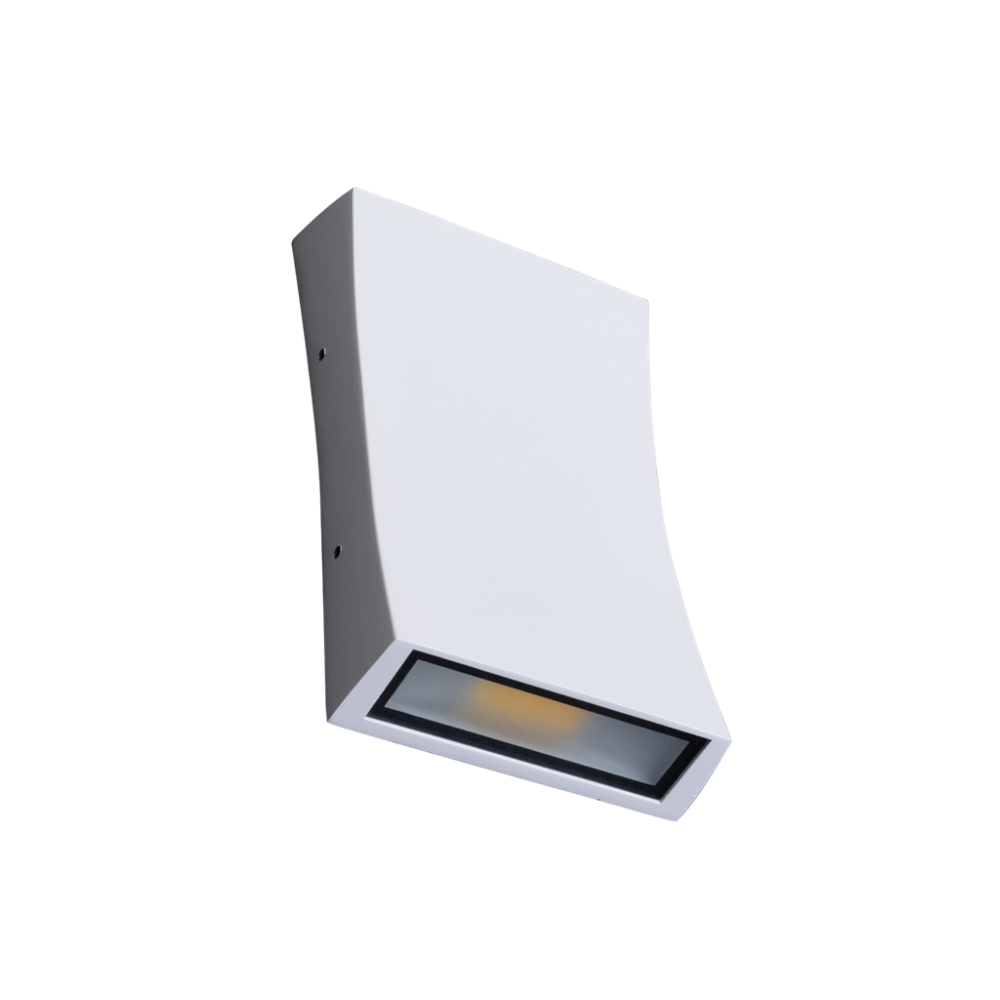
Price From $78.95. (Save 38%)
View the DENT Up & Down Wall Light
Installation: This fitting must be installed by a licensed electrician. Check the manufacturer's instructions to confirm its suitability for your intended location.
3A Six-Light Exterior LED Wall Light — Black
The 3A Six-Light Exterior LED Wall Light in Black is worth considering if you prefer a black finish and a multi-light design. Its listed specifications include colour temperature settings of 3000K, 4000K and 6500K, a light output of 500 lumens and a 64° beam angle.
The fitting's listed dimensions are 170 × 80 × 41 mm, and its IP rating is IP65. Compare these specifications with your available wall space and intended lighting effect, and confirm the manufacturer's installation requirements for your location before purchasing.

Price From $34.65. (Save 17%)
View the 3A Six-Light Exterior LED Wall Light
Installation: This fitting must be installed by a licensed electrician. Check the manufacturer's instructions to confirm its suitability for your intended location.
Which Product Should You Choose?
The DENT White Aluminium and 3A Black Six-Light wall lights offer different finishes, light outputs, beam angles and IP ratings. The right option depends on your preferred appearance, intended lighting effect and installation location.
Choose the DENT White Aluminium if:
-
You prefer a white exterior fitting.
-
You want selectable colour temperatures of 3000K, 4000K or 5000K.
-
Its listed light output of 810, 860 or 910 lumens and 81° beam angle suit your lighting requirements.
-
Its dimensions of 142 × 230 × 41 mm fit your available wall space.
-
Your intended location meets the manufacturer's stated installation requirements for this model.
Consider the 3A Black Six-Light if:
-
You prefer a black finish and multi-light design.
-
You want selectable colour temperatures of 3000K, 4000K or 6500K.
-
Its listed light output of 500 lumens and 64° beam angle suit your intended lighting effect.
-
Its dimensions of 170 × 80 × 41 mm fit your available wall space.
-
Its listed IP65 rating and the manufacturer's installation guidance are appropriate for your intended location.
Before choosing either fitting, compare its specifications with your lighting needs and available wall space. Confirm that the manufacturer's installation requirements suit your location, and have a licensed electrician carry out the installation.
Pre-Purchase Checklist for Outdoor Wall Lights
Before buying up and down outdoor wall lights, check that you have:
- Compared lumens and beam angle for the intended lighting effect.
- Checked the fitting's dimensions and mounting position.
- Confirmed the IP rating and manufacturer's suitability guidance for the installation location.
- Selected a colour temperature that works with nearby lighting.
- Checked the installation instructions and whether a licensed electrician is required.
Frequently Asked Questions
Are up and down wall lights suitable for outdoor use?
Some are designed for outdoor installation, while others are intended for indoor or covered locations. Check the individual product's IP rating, stated usage and installation instructions before purchasing.
What colour temperature is best for outdoor wall lights?
Warm white can create a softer appearance, while neutral or cooler white can produce a crisper effect. Choose according to the property's exterior materials, intended atmosphere and the colour temperature of nearby lighting.
Are LED up and down wall lights energy efficient?
LED fittings can provide useful illumination with relatively low electrical power consumption, but efficiency varies by product. Compare the rated wattage and lumen output rather than assuming every LED fitting performs equally.
Can up and down wall lights be installed on a rendered or brick wall?
The wall material, mounting method, cable entry and fixing requirements must be compatible with the chosen fitting. Have a licensed electrician confirm the installation requirements where electrical work is involved.
Shop Up and Down Outdoor Wall Lights at Lights4Less
Explore the Lights4Less Up / Down Wall Lights collection to compare finishes, designs and product specifications. Check each fitting's light output, beam angle, IP rating and installation requirements to find an option suited to your exterior and intended use.