
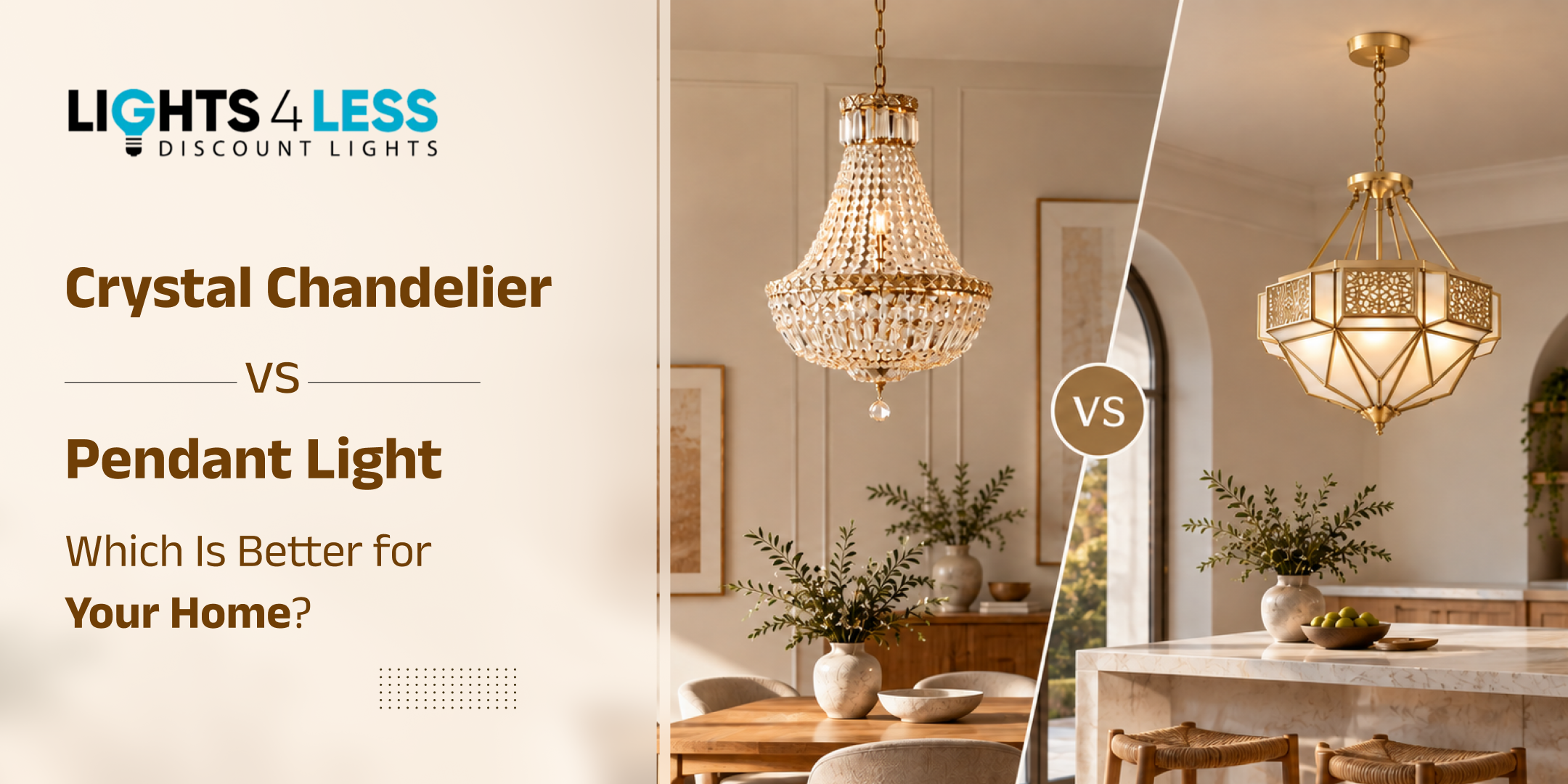
Choosing between a crystal chandelier vs pendant light usually comes down to the room, ceiling height, visual impact and the type of lighting you need. A crystal chandelier creates a more dramatic, decorative focal point, while a pendant light generally offers a simpler and more flexible solution for kitchens, dining areas, bedrooms and other everyday spaces.
If you are deciding between a chandelier or pendant light, the best option is not necessarily the more expensive or elaborate fitting. It is the one that suits the scale of your room, works with your furniture and provides the right combination of functional and decorative lighting.
Crystal Chandelier vs Pendant Light: What Is the Difference?
The main difference is scale, structure and visual impact.
A chandelier typically has multiple light sources or branches arranged around a central structure and is designed to make a strong decorative statement. A crystal chandelier adds reflective elements that can create sparkle and visual interest when illuminated.
A pendant light usually hangs from the ceiling using a single suspension point, although some designs can contain multiple light sources. Pendant lights are available in a wide range of shapes, materials, sizes and finishes, making them suitable for both practical and decorative applications.
|
Feature |
Crystal Chandelier |
Pendant Light |
|
Visual impact |
High and decorative |
Low to moderate, depending on design |
|
Typical design |
Ornate, elegant or statement-focused |
Minimal, contemporary, classic or decorative |
|
Light sources |
Often multiple |
Usually one, but varies by design |
|
Best suited to |
Entryways, dining rooms, larger living areas |
Kitchens, dining areas, bedrooms and smaller spaces |
|
Ceiling requirement |
Generally benefits from more vertical space |
Available for a wider range of ceiling heights |
|
Styling |
Traditional, luxury, glamorous or statement interiors |
Almost any interior style |
|
Main purpose |
Decorative focal point plus illumination |
Functional, ambient or decorative lighting |
The important point is that chandelier vs pendant light is not simply a choice between two styles. Each fitting can perform a different role within a home's lighting plan.
When Is a Crystal Chandelier Better?
A crystal chandelier can be the stronger choice when you want the light fitting itself to become a major feature of the room.
The reflective surfaces of crystal can interact with the light source and surrounding finishes, creating a more noticeable visual effect than a simple pendant.
Choose a Crystal Chandelier If You Want a Statement Feature
If your room has enough visual space for a feature fitting, a chandelier can provide a strong centrepiece above a dining table, in an entry area or within a suitably proportioned living space.
Rather than treating the chandelier as an isolated decoration, consider what it will sit alongside. Large furniture, detailed architectural features and other strong decorative elements can compete with an elaborate chandelier.
A useful approach is to let the chandelier become the primary decorative feature and keep surrounding lighting and décor relatively balanced.
Crystal Chandeliers Suit Formal and Glamorous Interiors
Crystal chandelier lights can work particularly well with interiors that already use materials and finishes associated with a more sophisticated aesthetic.
Depending on the design, they can complement:
- Classic interiors
- Glamorous spaces
- Contemporary luxury interiors
-
Formal dining rooms
-
Elegant entryways
-
Statement living areas
However, crystal does not automatically mean traditional. A more streamlined crystal design can work within a contemporary home when its proportions and finish complement the rest of the interior.
When Is a Pendant Light Better?
A pendant light is often the more versatile option when you need targeted illumination, a simpler appearance or a fitting that works comfortably within a smaller space.
Pendant lights can be particularly useful where the lighting needs to relate directly to furniture or a specific activity.
Pendant Lights Work Well Above Kitchen Islands
A pendant above a kitchen island can provide focused illumination while also contributing to the overall design of the kitchen.
When using multiple pendants, the important considerations are the size of the island, the diameter of each fitting, the number of pendants and the available ceiling space.
Avoid choosing the number of pendants first and trying to make the island fit around them. Start with the furniture or island dimensions and then select a suitable lighting arrangement.
Chandelier or Pendant Light: Which Is Better for Different Rooms?
The room should play a major role in your decision.
Dining Room
Both options can work well in a dining room.
A crystal chandelier is a strong choice when the dining area is designed around a formal or decorative centrepiece. A pendant can be preferable when you want a cleaner look or when the dining area has a more contemporary aesthetic.
The fitting should relate to the dining table rather than simply the size of the room.
Example: A long dining table may suit a larger linear fitting or a carefully spaced group of pendants, while a compact round table may work better with a single appropriately sized feature fitting.
The products and specifications in the examples below are taken from Lights4Less product listings. The room and furniture dimensions are illustrative examples designed to show how fitting size and room proportions can influence the decision.
Example 1: 1.8m Dining Table – Statement Chandelier or Linear Pendant?
Example room setup
- Dining table: 1.8m long x approximately 900mm wide
- Ceiling height: 2.7m
- Interior style: Contemporary/classic
- Main requirement: Dining illumination with a strong decorative feature
Option 1: Pimlico 9 Light Chandelier Dark Bronze - PM9-DB

- Width: 860mm
- Height: 860mm
- Minimum/maximum drop: 960-2820mm
- Light sources: 9
- Globe base: E14
- Material: Brass and crystal
- Finish: Dark Bronze
Why we would consider it
At 860mm wide, the Pimlico has enough visual presence to act as the main feature above a substantial dining table. Its crystal detailing and 860mm fitting height give it considerably more decorative and vertical presence than a simple pendant.
For this example, we would consider it when the homeowner wants the light itself to become one of the dominant design elements in the dining room.
We would be more cautious with a chandelier of this scale if the ceiling were lower, the dining table substantially smaller or the room already contained several other strong decorative features.
Option 2: Contrada 3 Light Island Pendant Antique Brass - IL.211.11.OR

- Width: 1085mm
- Suspension length: 900-1200mm
- Light sources: 3
- Globe base: E27
- Material: Copper and brass
- Finish: Antique Brass
Why we would consider it instead
The Contrada uses a 1085 mm linear form, making it particularly suited to a rectangular dining table. On a 1.8m table, the fitting width is approximately 60% of the table length.
This creates a clear visual relationship between the pendant and the furniture below without introducing the same vertical scale or decorative weight as the Pimlico chandelier.
It is the stronger choice when the homeowner wants the lighting to follow the shape of the dining table while maintaining a cleaner, more restrained appearance.
Which would we choose?
Choose the Pimlico chandelier when:
- The fitting should be a major statement feature.
- The room has sufficient vertical space
- Crystal detailing complements the interior.
- Decorative impact is a priority.
Choose the Contrada pendant when:
- The dining table is long and rectangular.
- You want the fitting to visually follow the table.
- A cleaner, more contemporary appearance is preferred.
- You don't want the lighting to dominate the whole room.
For pendant lighting above a dining table, approximately 750-900mm above the tabletop is a useful starting range, with the final position adjusted for fitting size, ceiling height and sightlines.
Kitchen
Pendant lights are generally the more practical choice for kitchen islands and breakfast bars because they can be positioned to provide illumination where food preparation, dining or other activities take place.
A crystal chandelier may work in a larger open-plan kitchen or dining zone where decorative impact is a priority, but its size and visual complexity need to suit the surrounding cabinetry and surfaces.
Example 2: 2.4m Kitchen Island – Why Multiple Pendants Usually Make More Sense
Example room setup
- Kitchen island: 2.4m long x approximately 900mm wide
- Ceiling height: 2.7m
- Main requirement: Practical island lighting with decorative interest
Product example: Skye 1 Light Pendant - QN-SKYE-1P

- Width: 274 mm
- Fitting height: 328 mm
- Light sources: 1 per pendant
- Globe base: E27
- Maximum wattage: 60W
- Cable: More than 3m supplied and can be shortened to suit the required hanging height
- Product positioning: Suitable for use in multiples over kitchen islands or dining tables
How we would approach it
For a 2.4m island, three Skye pendants create a practical example of how fitting size, spacing and quantity should be considered together. Because each Skye pendant is 274 mm wide, the fittings are compact enough to evaluate as a repeated arrangement rather than one oversized feature.
Lights4Less pendant-spacing guidance uses approximately 600-800 mm between the centres of smaller-to-medium pendants as a starting point, before adjusting for actual pendant diameter and island dimensions.
For hanging height, approximately 750-900 mm between the benchtop and the bottom of the pendant is a useful starting range, then adjust for the people using the kitchen, pendant dimensions and sightlines.
Why pendants make sense here
Kitchen-island lighting usually needs to relate directly to the work surface. Using individual pendants gives greater control over:
- Number of fittings
- Position
- Spacing
- Hanging height
- Visual scale
- Light distribution
The important point is not to decide first that an island needs three pendants. A larger pendant may require fewer fittings, while smaller pendants may work better as a repeated arrangement.
Lights4Less recommendation
Use this order when planning island lighting:
- Island dimensions
- Pendant dimensions
- Number of fittings
- Spacing
- Final hanging height
For example, three 274mm pendants can work very differently from three 500mm pendants over exactly the same island. Pendant diameter and quantity therefore need to be considered together.
Entryway
A chandelier can create a memorable first impression in an entrance area, particularly where the ceiling provides sufficient vertical space.
For a smaller entry, a pendant can provide a similar decorative focal point while keeping the overall installation more visually restrained.
Bedroom
Pendant lighting can work well as a decorative alternative to conventional bedside lighting, particularly when suspended on either side of the bed.
A crystal chandelier can also be used as a bedroom feature where the overall interior style and ceiling height allow it, but the fitting should not dominate the room.
Pendant Light vs Chandelier: How Do You Choose the Right Size?
Size should be determined by the relationship between the fitting, room, furniture and ceiling rather than by the room's floor area alone.
This is one of the most important differences between selecting a chandelier and selecting a pendant.
Before choosing a chandelier or pendant, measure:
-
Ceiling height
-
Table/island length and width
-
Available clearance
-
Fitting diameter/width
-
Fitting height
-
Suspension/drop length
Use those measurements together rather than in isolation:
|
Factor |
Why it matters |
|---|---|
|
Furniture dimensions |
The fitting should visually relate to the table, island or furniture beneath it. |
|
Fitting dimensions |
Width controls horizontal scale; height is especially important with large or vertically detailed chandeliers. |
|
Suspension/drop |
Determines whether the fitting can be positioned correctly for the ceiling and furniture. |
|
Light sources and direction |
Influence illumination, visual character and whether the fitting is mainly task, ambient or decorative lighting. |
|
Existing lighting |
A pendant or chandelier does not necessarily need to provide every layer of illumination. |
|
Ceiling height and sightlines |
Determine how much vertical space is available without obstructing normal use or views. |
|
Interior style |
Helps determine whether the fitting should dominate the room or support the surrounding design. |
The better question is not simply whether a chandelier or pendant is better. Ask which specific fitting has the right dimensions, lighting role and visual scale for the particular space.
Avoid selecting a fitting simply because its product photograph looks impressive online. A fitting that looks appropriately proportioned in a large showroom or lifestyle image can appear very different when installed in a smaller Australian home.
Crystal Chandelier vs Pendant Light for Low Ceilings
For lower ceilings, the physical depth of the fitting becomes especially important.
A chandelier with substantial vertical drop may not be suitable where there is limited clearance. In these situations, a more compact pendant or a fitting with a shorter suspension arrangement may be easier to integrate.
The goal is not simply to choose the smallest fitting available. It is to find a design that provides sufficient visual presence without compromising the room's usable space or sightlines.
If you are unsure about the suitability of a ceiling fitting, installation should be assessed by a suitably qualified professional.
What About Lighting Performance?
The appearance of a light fitting is only one part of the decision.
When comparing a crystal chandelier vs. a pendant light, also consider how the fitting distributes light around the room.
Look at:
-
Number of light sources
-
Lamp type and compatibility
-
Brightness requirements
-
Light direction
-
Colour temperature
-
Whether dimming is supported
-
Existing ceiling or task lighting
-
Whether the fitting provides ambient, task or primarily decorative lighting
A chandelier may create a strong decorative effect without being the only source of useful illumination in a large room. Similarly, a pendant above a kitchen island may provide task lighting but still needs to work alongside other kitchen lighting.
The best lighting result often comes from combining different types of lighting rather than expecting one fitting to perform every function.
Crystal Chandelier Lights vs Crystal Pendant Lights
If you specifically like the reflective appearance of crystal, you do not necessarily have to choose a traditional chandelier.
If you like the reflective appearance of crystal but do not have the space for a traditional chandelier, a more compact crystal-inspired or crystal-detail pendant can provide an alternative.
This creates a useful middle ground:
-
A chandelier provides a larger statement.
-
A crystal pendant provides decorative detail in a more compact format.
-
A standard pendant provides greater flexibility across different interior styles.
For smaller dining rooms, bedrooms or apartments, a crystal pendant can provide some of the visual character associated with crystal lighting without requiring the scale of a traditional chandelier.
Example 3: You Want Crystal, but a Full Chandelier Is Too Large
Example room setup
- Room type: Compact dining room, bedroom or smaller feature area
- Ceiling height: 2.4-2.7 m
- Main requirement: Crystal detail without the scale of a large chandelier
Option : Bellini 1 Light Pendant - FE-BELLINI-P

- Width: 222 mm
- Height: 405 mm
- Minimum/maximum drop: 480-1980 mm
- Light sources: 1
- Globe base: E14
- Maximum wattage: 60W
- Decorative detail: Antique quartz crystal
- Finish: Oxidised Bronze / British Bronze
Why the crystal pendant can make more sense
The difference in scale is substantial. The Pimlico chandelier is 860mm wide and 860mm high, while the Bellini pendant is only 222mm wide and 405mm high.
The Bellini retains decorative crystal detailing but packages it into a much narrower one-light fitting. Its width is roughly one quarter of the Pimlico's, which helps explain why a crystal pendant can be easier to integrate into a compact room.
Consider the Bellini-style approach when:
• The room cannot comfortably accommodate a large chandelier.
• You want crystal detailing without making it the dominant element.
• The fitting is being positioned above a smaller table or another defined area.
• You want a more compact decorative feature.
• The room already contains other strong design elements.
Lights4Less recommendation
Do not force a chandelier into a room simply because the desired look is crystal. First decide how much physical and visual space the room can support, then choose the fitting format. A crystal pendant can provide a useful middle ground between a large traditional chandelier and a completely minimal pendant.
Common Mistakes When Choosing Between a Chandelier and Pendant
Choosing Based Only on Appearance
A fitting can look attractive in a product image but still be unsuitable for your room.
Check dimensions, suspension length, furniture placement and ceiling height before making the decision.
Ignoring the Furniture Below
For dining and kitchen applications, the relationship between the light and the furniture beneath it is critical.
The fitting should look intentionally positioned rather than appearing too small, too large or disconnected from the furniture.
Making the Light the Only Source of Illumination
Decorative lighting and functional lighting are not always the same thing.
A chandelier or pendant may need to work with downlights, wall lights or other lighting layers depending on the room.
Choosing Too Many Competing Features
If the chandelier is highly decorative, adding numerous other statement elements can make the room feel visually crowded.
Use the lighting fitting as part of the overall interior composition.
So, Which Is Better: Crystal Chandelier or Pendant Light?
A crystal chandelier is better when you want a dramatic decorative centrepiece and have sufficient space for the fitting. A pendant light is usually better when you need greater flexibility, targeted illumination or a more streamlined design.
For a formal dining room or spacious entryway, a well-proportioned crystal chandelier can create the strongest visual impact.
For a kitchen island, compact dining area, bedroom or smaller room, a pendant light can provide a more adaptable solution.
If you love crystal but have limited space, a crystal pendant can provide a practical compromise.
The right decision ultimately depends on room proportions, ceiling height, furniture dimensions, lighting requirements and interior style rather than whether one fitting is universally better.
Explore Pendant and Chandelier Lighting at Lights4Less
Once you have decided whether your room needs a statement chandelier or a more versatile pendant, compare fittings based on their dimensions, finish, light source and intended application.
For shoppers looking for crystal chandeliers, crystal pendant lights or contemporary pendant designs in Australia, Lights4Less offers options to explore for different rooms and interiors.
View our pendant lights collection.

View our chandelier/crystal lighting collection

Frequently Asked Questions
Are crystal pendant lights suitable for Australian homes?
Yes, crystal pendant designs can suit Australian homes when their size, finish and styling complement the room. The fitting should be selected according to the room's proportions and intended lighting function.
Can you use a crystal chandelier in a small room?
You can, but the chandelier's dimensions and suspension height need to be appropriate for the room. An oversized fitting can dominate a compact space, so measure the available area before choosing one.
Do I need an electrician to install a chandelier or pendant light?
Ceiling light installation involves electrical work. Use a suitably qualified electrician and ensure the installation complies with applicable Australian electrical requirements and the product manufacturer's instructions.