
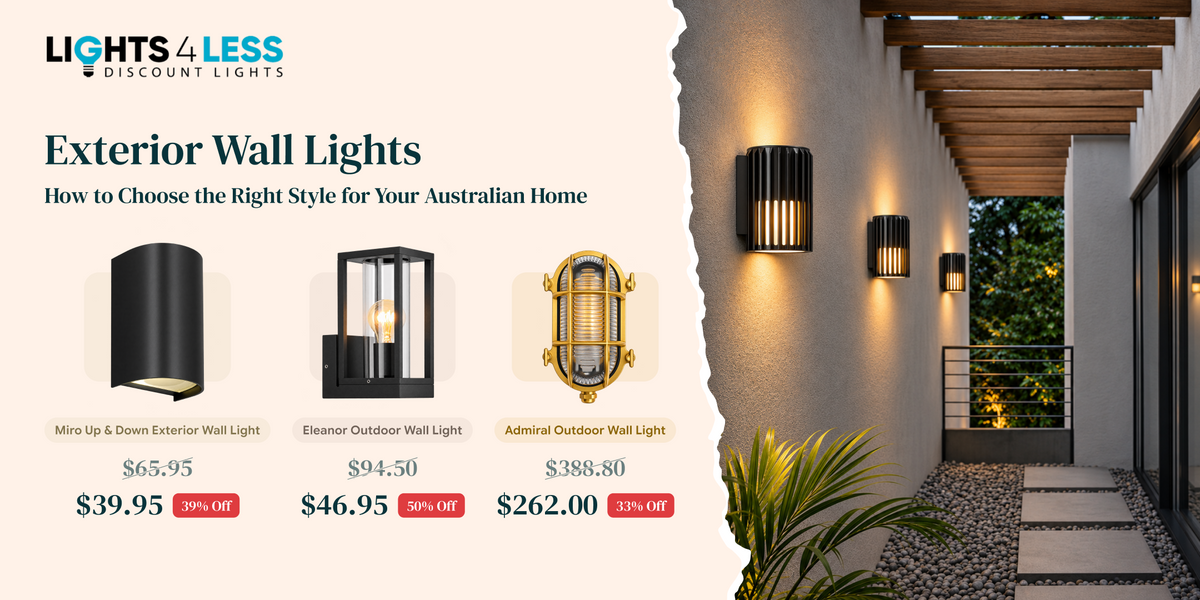
Exterior wall lights illuminate entrances, improve visibility around outdoor access areas and highlight the architectural features of your home. Popular options for Australian homes include traditional wall lanterns, modern up-and-down lights and decorative fittings for verandahs and exterior walls.
Choosing the right exterior wall light involves more than appearance. Consider where the fitting will be installed, how much light it needs to provide, its wall projection, IP rating, materials and compatible globe requirements.
This guide compares exterior wall light styles and selected Lights4Less products, with practical advice on brightness, coastal suitability, sizing and placement.
Which Exterior Wall Light Suits Your Space?
The best exterior wall light depends on its location and the type of illumination required. Use the table below as a starting point when comparing styles.
| Outdoor location | Suitable lighting style | What to consider |
|---|---|---|
| Front entrance | Wall lantern or downward-facing fitting | Light around the doorway, steps and entry path |
| Modern facade | Up-and-down wall light | Beam pattern and wall finish |
| Covered verandah | Diffused or decorative wall light | Glare control and suitability for covered installation |
| Narrow side passage | Compact exterior wall light | Wall projection and available walking clearance |
| Alfresco area | Diffused wall lighting | Comfortable illumination around seating |
| Garage entrance | Functional or sensor-activated light | Coverage of the access area |
| Exposed exterior wall | Outdoor-rated wall light | IP rating and manufacturer installation instructions |
| Coastal property | Fitting approved for the intended coastal environment | Corrosion resistance, finish and warranty conditions |
A decorative wall light does not necessarily provide enough illumination for steps or walkways. For example, an up-and-down fitting can create an attractive effect on a rendered wall while leaving the ground below poorly lit. Check the light distribution and intended application before choosing a fitting.
Compare Exterior Wall Lights at Lights4Less
Comparing dimensions, IP ratings and globe types can help narrow down your options before you purchase. The following Lights4Less products demonstrate different exterior wall light styles, from compact up-and-down designs to traditional lanterns and decorative architectural fittings.
| Product | IP Rating | Dimensions (H × W × P) | Globe Type | Key Consideration |
|---|---|---|---|---|
| Telbix Miro EX2-BK | IP65 | 195 × 110 × 85 mm | 2 × GU10 | Compact up-and-down design |
| Mercator Eleanor MXW1020 | IP44 | 245 × 110 × projection not confirmed | E27 | Traditional lantern-style appearance |
| Nordlux Aludra 2118011203 | IP54 | 168 × 124 × 174 mm | E27 | Decorative architectural effect |
| Lighting Inspirations Admiral 1001201 | IP56 | 109 × 209 × 120 mm | E27 | Solid brass construction; check coastal warranty conditions |
What to Compare Before Choosing
Wall projection is particularly important when installing a light beside a doorway or narrow passage.
The Telbix Miro has a listed projection of 85 mm, compared with 174 mm for the Nordlux Aludra. This means the Aludra extends 89 mm farther from the wall.
The Mercator Eleanor's wall projection has not been confirmed in the available product information. Check its manufacturer dimension drawing before purchasing if clearance is a concern.
Also compare the fitting's material, finish, IP rating and compatible globe requirements. Always check the manufacturer's instructions to confirm that the product is suitable for the intended installation location.
Exterior Wall Light Styles and Product Examples
Modern Up-and-Down Wall Lights
Up-and-down wall lights direct illumination above and below the fitting, creating a distinctive lighting pattern on exterior walls. They can highlight entrance pillars, textured brickwork and contemporary facades.
Featured product: Telbix Miro Black – MIRO EX2-BK

The Telbix Miro Exterior Wall Light features a black polycarbonate body and two GU10 lamp holders. It has an IP65 rating and measures 195 mm high, 110 mm wide and 85 mm in wall projection.
Why consider the Telbix Miro?
Its compact 85 mm projection makes it worth considering where a modern up-and-down lighting effect is desired without a large fitting extending from the wall. It is also the smallest-projection option among the products compared in this guide with confirmed measurements.
The two GU10 lamp holders allow compatible globes to be selected separately, giving you flexibility over the light output and colour temperature.
Before purchasing: Confirm the permitted GU10 globe wattage, dimensions, lumen output, beam angle and colour temperature against the manufacturer's specifications.
Explore the up-and-down wall lights collection for more designs.
Traditional Outdoor Wall Lanterns
Outdoor wall lanterns can complement traditional entrances, verandahs and homes with decorative architectural details. Their glass shades and visible globe designs can make the fitting a feature of the exterior.
Featured product: Mercator Eleanor Black – MXW1020

The Mercator Eleanor Outdoor Wall Light features a black die-cast aluminium body and clear glass shade. It has an IP44 rating and uses an E27 globe, which is sold separately. Its listed dimensions include a length of 245 mm and width of 110 mm.
Why consider the Mercator Eleanor?
The Eleanor offers a traditional lantern-style appearance for buyers who want something different from a contemporary up-and-down fitting. Its clear glass shade also makes the choice of globe an important part of the final appearance.
Before purchasing, confirm the manufacturer's installation guidance and wall projection. The projection is not confirmed in the supplied specifications, so check the dimension drawing if the light will be positioned beside a narrow walkway or doorway.
Browse the outdoor wall lanterns collection for more traditional styles.
Decorative Architectural Wall Lights
Decorative exterior wall lights can add visual interest to a facade while creating distinctive patterns of light and shadow. They are worth considering when the appearance of the fitting is as important as its practical lighting function.
Featured product: Nordlux Aludra Seaside Black – 2118011203

The Nordlux Aludra Wall Light combines aluminium and plastic construction in a sculptural design. It has an IP54 rating, uses an E27 globe and measures 168 mm high, 124 mm wide and 174 mm in wall projection.
Why consider the Nordlux Aludra?
The Aludra is an option for buyers looking for a decorative fitting that creates a distinctive light-and-shadow effect on an exterior wall.
Its 174 mm projection is worth considering before installation. Measure the available clearance carefully, particularly beside doorways and narrow outdoor passages, where a deeper fitting may extend further into the available space.
Solid Brass Exterior Wall Lights
Brass exterior wall lights can complement traditional entrances and heritage-inspired architecture. Their appearance and maintenance requirements depend on the finish and the conditions in which the fitting is installed.
Featured product: Lighting Inspirations Admiral – 1001201

The Lighting Inspirations Admiral Solid Brass Outdoor Wall Light has an IP56 rating and an E27 globe holder. Its listed dimensions are 109 mm high, 209 mm wide and 120 mm in wall projection.
Why consider the Admiral?
The Admiral offers a traditional solid-brass appearance for exterior walls where a decorative fitting is preferred. Its wider body makes it worth comparing against the available wall space before installation.
Important coastal consideration: The supplied product information indicates warranty conditions relating to saltwater exposure. Do not assume that the brass construction or IP56 rating makes it suitable for every coastal location. Check the manufacturer's current warranty exclusions, approved installation environments and maintenance instructions before purchasing.
How to Choose the Right IP Rating for Exterior Wall Lights
An IP rating indicates how well an electrical fitting is protected against the entry of solid objects and water. The first digit refers to protection against solid objects and dust, while the second digit indicates protection against water.
The right rating depends on where the light will be installed and how much exposure it will experience.
| IP rating | Protection indicated | What to consider |
|---|---|---|
| IP44 | Protection against objects over 1 mm and splashing water | Check the manufacturer's permitted installation locations |
| IP54 | Dust-protected and protected against splashing water | Consider the fitting's exposure and installation guidance |
| IP55 | Dust-protected and protected against water jets | Check whether the fitting is approved for the intended exposed location |
| IP65 | Dust-tight and protected against water jets | Suitable only where the manufacturer's instructions approve the application |
| IP66 | Dust-tight and protected against powerful water jets | Check the product's installation requirements and exposure conditions |
An IP rating does not confirm resistance to salt corrosion, UV exposure or deterioration of the fitting's finish. These are separate considerations, particularly for coastal homes.
Before purchasing, check the manufacturer's approved installation locations, material and finish specifications, and warranty conditions.
Exterior Wall Light Materials and Coastal Suitability
The material and finish of an exterior wall light affect its appearance, maintenance requirements and suitability for different outdoor environments. Aluminium, polycarbonate and brass are used in exterior lighting, but the material name alone does not establish how well a product will perform in a particular location.
Aluminium
Aluminium is used across a range of contemporary exterior wall light designs. Check the product's surface treatment and protective finish, as these can influence its suitability for outdoor exposure.
Polycarbonate
Polycarbonate is used in some exterior light housings and offers an alternative to metal construction. Check the manufacturer's information about UV stability, construction and intended outdoor use.
The Telbix Miro is one example of a polycarbonate exterior wall light.
Brass
Brass can suit traditional and heritage-inspired exterior designs. Depending on the finish and exposure, its appearance may change over time. Check the manufacturer's maintenance guidance before choosing a fitting.
What Should Coastal Homeowners Check?
Before choosing an exterior wall light for a coastal property, confirm:
- Whether the manufacturer approves the fitting for the intended coastal environment.
- The housing material and protective finish.
- Any saltwater or salt-exposure warranty exclusions.
- Recommended cleaning and maintenance procedures.
- Any restrictions on installation location.
Do not rely on the IP rating alone to determine coastal suitability.
Choosing Brightness, Colour Temperature and Globe Type
The right globe for an exterior wall light depends on what you want the fitting to illuminate. Consider lumen output, beam angle and colour temperature together rather than choosing a globe based on brightness alone.
Lumens and Beam Distribution
Lumens measure the visible light output of a globe. Beam angle describes how widely the light spreads.
A narrower beam creates more concentrated illumination and may suit architectural features such as entrance pillars. A wider beam spreads light across a larger area and may be more appropriate for general access lighting.
The fitting's design, mounting position and surrounding surfaces also influence the final result.
How to Choose a Globe for Your Exterior Wall Light
Start with the purpose of the fitting:
- Front entrance: Consider illumination around the doorway, door handle, steps and approach. Avoid a globe and fitting combination that creates uncomfortable glare.
- Architectural feature: A narrower beam may help create a concentrated effect on a wall or entrance pillar. Check the fitting's design and the globe's actual beam angle.
- Outdoor passage: Consider the spread of light along the walking route and whether the arrangement leaves poorly illuminated areas.
When comparing compatible globes, check:
- Lumens: The amount of visible light produced.
- Beam angle: How concentrated or spread out the light will be.
- Colour temperature: Whether the light appears warm, neutral or cool.
- Compatibility: Permitted wattage, globe dimensions and manufacturer restrictions.
A higher lumen figure does not automatically produce better outdoor lighting. Beam direction, mounting position and glare control also affect visibility.
Warm White or Cool White?
| Colour temperature | Appearance | Potential application |
|---|---|---|
| 2700K | Warm white | Relaxed outdoor areas and traditional entrances |
| 3000K | Warm white | Residential facades and alfresco spaces |
| 4000K | Neutral white | Selected functional access areas |
| 5000K–6500K | Cool to daylight-like | Specific task applications where appropriate |
Warm-white light is often a comfortable choice for residential exterior spaces. However, cooler light is not automatically safer or more effective. Glare, contrast and light distribution also influence visibility.
Integrated LED or Replaceable Globes?
Exterior wall lights may have integrated LEDs or replaceable globes.
- Integrated LED fittings: Check the manufacturer's service-life information and replacement arrangements.
- Replaceable-globe fittings: Confirm the permitted wattage, globe dimensions, dimming compatibility and any restrictions on compatible lamps.
The featured Telbix Miro uses GU10 globes, while the Mercator Eleanor, Nordlux Aludra and Lighting Inspirations Admiral use E27 globes.
Explore the outdoor LED wall lights collection for additional options.
Exterior Wall Light Size, Projection and Placement
Before purchasing an exterior wall light, measure the available wall area and compare it with the fitting's height, width and projection. Projection is especially important beside doorways and narrow passages, where a deeper fitting may reduce available clearance.
Front Entrance Placement
A single wall light may suit a smaller entrance, while a pair of fittings can create a balanced appearance around a wider doorway.
Before choosing the position, consider nearby windows, door hardware, steps and the direction of the light. The aim is to provide useful illumination without creating uncomfortable glare.
Narrow Passage Placement
For narrow outdoor passages, compare the fitting's projection with the available walking clearance.
For example, the listed product dimensions show:
- Telbix Miro: 85 mm wall projection.
- Nordlux Aludra: 174 mm wall projection.
The Aludra projects 89 mm farther from the wall than the Miro. This makes projection an important comparison when choosing a fitting for a confined space.
Before purchasing, measure the available clearance and check whether the fitting's light distribution will provide useful illumination along the walkway.
Spacing Multiple Exterior Wall Lights
There is no single spacing distance or mounting height that suits every exterior wall light.
The layout depends on the fitting's beam distribution, wall dimensions, mounting instructions and intended lighting effect.
For decorative lighting, consider how adjacent beams will appear together. For access areas, focus on useful light coverage without poorly illuminated gaps or excessive glare.
Follow the manufacturer's mounting instructions and have fixed-wired fittings installed by an appropriately licensed electrician.
Exterior Wall Light Buying Checklist
Before ordering an exterior wall light, check the following:
- Purpose: Do you need functional illumination, decorative lighting or both?
- Location: Will the fitting be installed under cover, on an exposed wall or in a coastal environment?
- IP rating: Is the fitting approved for the expected exposure?
- Material and finish: Are they suitable for the intended outdoor conditions?
- Dimensions: Do the height, width and wall projection fit the available space?
- Light output: Are the lumen output and beam distribution appropriate for the area?
- Globe requirements: Is the lamp type compatible, and what wattage is permitted?
- Maintenance: What cleaning and light-source replacement will be required?
- Warranty: Are there relevant exclusions or installation conditions?
- Installation: Have you checked the manufacturer's instructions and applicable Australian electrical requirements?
Fixed-wired exterior wall lights should be installed by an appropriately licensed electrician in accordance with applicable Australian requirements.
Frequently Asked Questions About Exterior Wall Lights
Can exterior wall lights be installed on brick or rendered walls?
Yes. Exterior wall lights can be installed on brick or rendered walls when the mounting method and fixings are suitable for the wall construction. The installation may also require appropriate cable access and weather sealing. Have a licensed electrician assess the installation and follow the manufacturer's instructions.
Can I replace an existing exterior wall light with a different style?
Often, yes. However, the replacement fitting must be suitable for the installation environment and existing electrical arrangement. An electrician can assess mounting compatibility, wiring and any modifications required.
Are IP-rated exterior wall lights suitable for coastal properties?
Not automatically. An IP rating describes protection against the entry of solid objects and water; it does not confirm resistance to salt corrosion.
For coastal installations, check the manufacturer's approved-use guidance, material and finish specifications, maintenance requirements and warranty conditions.
What is the difference between exterior wall lights and security wall lights?
Exterior wall lights include decorative and functional fittings for entrances, facades and outdoor living areas. Security wall lights are generally selected to illuminate access areas and may include motion sensors or adjustable light heads.
For a garage entrance or side gate, consider whether you need automatic activation, broader illumination or a decorative lighting effect.
Can exterior wall lights work with smart globes?
Some exterior wall lights with replaceable globes may support compatible smart globes. Compatibility depends on the fitting, globe dimensions, electrical controls and manufacturer's requirements. Check the product specifications before purchasing.
Shop Exterior Wall Lights at Lights4Less Australia
Explore the Lights4Less exterior wall lights collection to compare modern up-and-down fittings, traditional outdoor lanterns and decorative exterior designs.
Check product dimensions, IP ratings, materials and globe requirements to find an exterior wall light that suits your home's entrance, facade or outdoor living area.