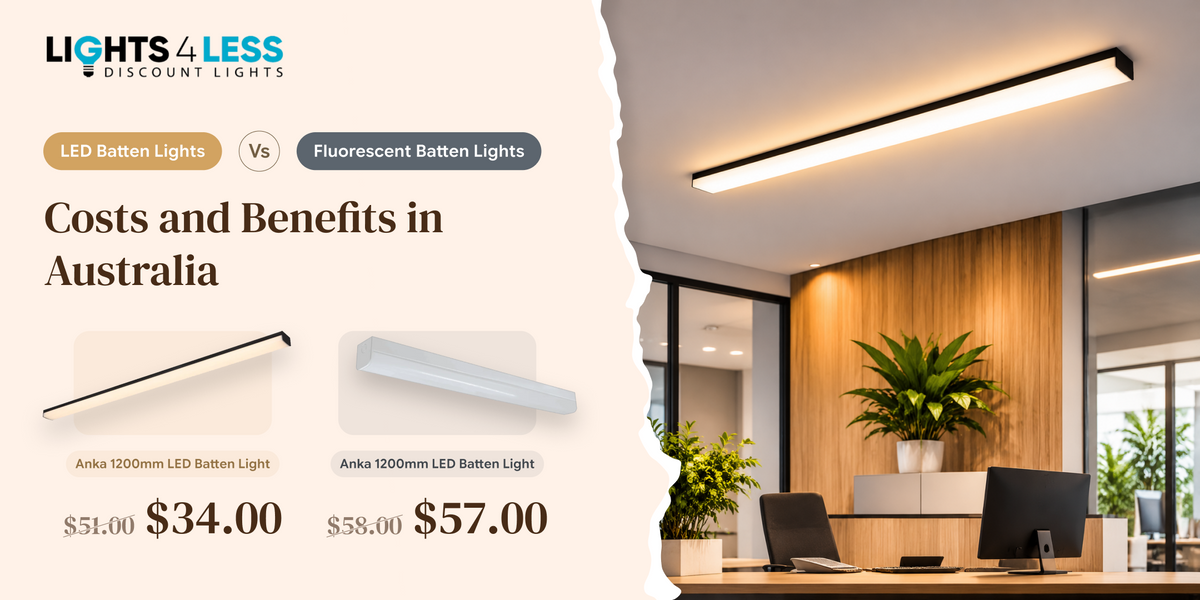
LED batten lights can use less electricity than older fluorescent fittings, potentially helping reduce energy bills over time. However, choosing the right replacement involves more than comparing wattage alone.
For Australian homes and businesses, factors such as light output, upfront costs, installation requirements and how often the lights are used all matter. This guide compares LED and fluorescent batten lights to help you understand their running costs, key benefits and which option may best suit your garage, laundry, workshop or commercial space.
What Is the Difference Between Fluorescent Batten Lights and LED Batten Lights?
A batten light is a long, narrow light fitting commonly installed on ceilings or walls. Traditional fluorescent battens use fluorescent tubes to produce light, while LED battens use light-emitting diodes (LEDs).
The key difference is how each type produces light and how much electricity it uses to deliver the required illumination. However, performance varies between models. When comparing fittings, consider light output, energy consumption, maintenance needs, purchase price and compatibility with your existing installation.
| Feature | Traditional fluorescent batten | LED batten light |
|---|---|---|
| Light source | Fluorescent tube or tubes | Integrated LEDs or compatible LED replacement tubes |
| Electricity use | Depends on tube wattage, ballast and fitting | Depends on the product's rated power and efficiency |
| Brightness | Varies by tube type, number and condition | Varies by lumen output and light distribution |
| Maintenance | Fluorescent tubes and components may need replacement | Maintenance depends on product design and service life |
| Replacement options | Replace compatible tubes or the complete fitting, depending on its condition and requirements | Install a complete LED fitting or use a compatible LED replacement tube where permitted by the product instructions |
| Upfront cost | Keeping an existing fitting may cost less initially | A new fitting has an upfront purchase and potentially installation cost |
| Buying considerations | Tube type, ballast, condition and replacement availability | Lumens, watts, dimensions, colour temperature, warranty and installation |
Important: An LED replacement tube is not automatically compatible with every fluorescent fitting. Check the manufacturer's instructions and compatibility requirements before purchasing replacement components.
Are LED Batten Lights More Energy Efficient?
LED batten lights can use less electricity than fluorescent fittings, but the difference depends on the specifications of the products being compared. To assess efficiency, look at luminous efficacy, measured in lumens per watt (lm/W). This indicates how much light a fitting produces for each watt of electricity it consumes.
For a fair comparison, check the total power consumption and lumen output of both fittings. Make sure the LED option provides suitable illumination for the intended space rather than comparing wattage alone.
For example, a fluorescent fitting with two tubes should be compared with an LED product that provides suitable light output for the same task. Comparing the wattage of one fluorescent tube with the wattage of an entire LED fitting can produce a misleading result.
Why Lumens Matter More Than Wattage Alone
Watts measure electrical power consumption. Lumens measure the amount of light produced.
When selecting an LED batten, look at the lumen rating to understand its stated light output, then compare that figure with the lighting required in your space. Also consider beam distribution, mounting height, room layout and whether the light is intended for general illumination or detailed work.
For Australian buyers, this is particularly relevant when choosing battens for garages, laundries, workshops, storerooms and commercial work areas.
LED Batten Lights vs Fluorescent Battens: Which Costs Less to Run?
LED batten lights may cost less to run if they use less electricity than the existing fluorescent fitting while providing suitable illumination. You can estimate the difference by comparing each fitting's total power consumption, daily operating hours and your electricity tariff.
Use this formula:
Annual electricity cost = Power in kW × Hours used per day × Days used per year × Electricity tariff per kWh
Here is an illustrative comparison of two fittings, assuming each is operated for 8 hours per day, 365 days per year, with an electricity tariff of $0.30 per kWh. These are example inputs, not specifications for particular Lights4Less products or a claim about typical Australian electricity prices.
| Example fitting | Power | Annual energy use | Annual electricity cost |
|---|---|---|---|
| Existing fitting | 72W | 210.24 kWh | $63.07 |
| LED replacement | 36W | 105.12 kWh | $31.54 |
| Difference | 36W less | 105.12 kWh saved | $31.54 saved |
Under these assumptions, the 36W LED fitting uses half as much electricity as the 72W example fitting. The estimated annual electricity saving is $31.54 per fitting, based on eight hours of daily operation and an electricity tariff of $0.30 per kWh.
This is an illustrative calculation, not a guaranteed saving. The light output and distribution of the two fittings have not been established as equivalent, so the example does not prove that the LED fitting will provide the same illumination. Actual savings depend on the specifications of the fittings, operating hours and electricity tariff.
The estimate also excludes the purchase price of the replacement, installation costs, maintenance and any changes to electricity prices.
How Long Could It Take to Recover the Replacement Cost?
To estimate the simple payback period, divide the total replacement cost by the estimated annual electricity savings.
Simple payback period = Total replacement cost ÷ Estimated annual electricity savings
For example, if replacing a fitting costs $100 in total and the estimated annual electricity saving is $31.54, the simple payback period would be approximately 3.2 years.
This is an illustrative calculation based on the running-cost example above, assuming the estimated annual saving remains consistent. Actual payback will depend on the replacement cost, installation expenses, electricity tariff, operating hours and whether the new fitting provides suitable illumination.
What Are the Benefits of LED Batten Lights?
1. Potentially Lower Running Costs
An LED batten may reduce electricity costs when it provides suitable illumination while consuming less power than the existing fluorescent fitting. The potential saving depends on the power consumption of both fittings, operating hours and your electricity tariff.
Use the running-cost calculation above to estimate whether replacing your existing fitting could be worthwhile.
2. Less Frequent Maintenance
Some LED batten lights may require less frequent light-source replacement than traditional fluorescent fittings, depending on their design and rated service life. This can be useful in workshops, warehouses and other spaces where accessing ceiling-mounted lights is difficult.
Check the manufacturer's rated lifetime, warranty and replacement arrangements before purchasing. Rated service life is not a guarantee of how long every fitting will operate in practice.
3. Different Colour Temperature Options
LED batten lights are available in different colour temperatures, depending on the model.
- Warm white: Can create a softer, warmer appearance in suitable residential spaces.
- Neutral white: Offers a balanced appearance for general-purpose lighting.
- Cool white or daylight-style white: May suit garages, workshops and task-focused areas where a crisper appearance is preferred.
Check the product specifications to confirm the available colour temperatures. Some models offer selectable settings, while others have a fixed colour temperature.
4. A Choice of Designs and Features
LED battens are available in different lengths, finishes and configurations to suit different installations. Depending on the model, features may include selectable colour temperatures, linking capabilities or dimming compatibility.
Before buying, confirm that the fitting's dimensions, features and installation requirements suit your space.
When Does It Make Sense to Replace a Fluorescent Batten Light?
Replacing a fluorescent batten may be worth considering if the fitting is deteriorating, replacement tubes are difficult to source, maintenance is becoming frequent or the light output no longer meets your needs. An LED upgrade may also be worth evaluating in spaces where lights operate for long periods each day.
A replacement may be less urgent when the existing fitting works properly, is suitable for the application and has low operating hours. In that case, compare the likely running-cost savings with the cost of purchasing and installing a new fitting before making a decision.
| Situation | What to consider |
|---|---|
| Garage or laundry used daily | Compare light output, energy consumption and the existing fitting's condition. |
| Workshop with long operating hours | Calculate potential running-cost savings and consider maintenance access. |
| Warehouse or commercial premises | Compare total power consumption across all fittings and check the required lighting performance. |
| Older fittings needing repairs | Compare the cost of repair with the cost of a suitable replacement. |
| Existing fitting still works well | Calculate potential savings before deciding whether early replacement is worthwhile. |
For installations with several fittings, calculate the combined power consumption rather than assessing just one light. Small differences per fitting can become more significant across a large installation.
How to Choose the Right LED Batten Light
Before purchasing an LED batten, compare the specifications that affect its performance, suitability and installation.
Check Lumen Output
Lumens indicate the stated amount of light produced by a fitting. Choose an output suitable for the space and the tasks performed there. Also consider light distribution, mounting height and the position of workbenches or other important surfaces.
Compare Wattage and Efficiency
Check the fitting's rated power consumption and lumen output. Where reliable specifications are available, compare lumens per watt (lm/W) to assess efficiency. Make sure the products provide suitable lighting for the intended task before comparing energy use.
Measure the Existing Fitting
Measure the existing fitting and check its length, width, mounting points and available ceiling space. Confirm whether the replacement can use the existing mounting arrangement or whether installation changes may be required.
Select the Right Colour Temperature
Choose a colour temperature that suits the space and the appearance you want. If other lights are already installed in the room, consider how the new fitting will look alongside them. Check the product specifications to confirm whether the colour temperature is fixed or selectable.
Check Warranty and Installation Requirements
Review the warranty, IP rating, product instructions and suitability for the intended location. Confirm any installation requirements before buying. Electrical installation work should be carried out by a suitably licensed electrician where required.
Compare LED Batten Lights at Lights4Less
The two LED battens below offer different power ratings, lumen outputs and colour temperature options. Compare their specifications to understand which features best match your lighting requirements.
LED Batten Light Comparison
| Specification | Telbix Anka 1200mm LED Batten | 3A MIRA3 1200mm LED Batten |
|---|---|---|
| Rated power | 36W | 40W |
| Length | 1,200 mm | 1,200 mm |
| Lumen output | 3,200 lm | 3,500 lm at 3000K; 3,800 lm at 4000K; 3,650 lm at 5700K |
| Colour temperature | 2700K / 3000K / 4000K | 3000K / 4000K / 5700K |
| Colour rendering (CRI) | Greater than 90 | Greater than 80 |
| Dimmable | No | No |
| IP rating | IP20 | IP20 |
| Warranty | 3-year replacement warranty | 3-year replacement warranty |
View the products:

$33.86 Regular price$50.95

The Telbix Anka has a lower rated power consumption at 36W, while the 3A MIRA3 is rated at 40W and lists different lumen outputs depending on the selected colour temperature. These specifications help illustrate the trade-off between electrical power and stated light output.
However, wattage and lumens alone do not establish which fitting will perform better in a particular room. Compare the required brightness, light distribution, colour temperature, physical dimensions and installation requirements before choosing between the two options.
Both products are listed with an IP20 rating, so do not assume they are suitable for exposed outdoor locations or areas subject to water. Check the current product specifications and installation instructions to confirm suitability for your intended application.
Browse the Lights4Less LED Batten Lights collection to compare additional options.
Frequently Asked Questions
Can I replace a fluorescent batten with an LED batten?
A complete LED batten may be suitable, but check the new fitting's dimensions, mounting requirements and installation instructions. Replacing only the fluorescent tubes with LED tubes depends on compatibility with the existing fitting and ballast. Consult a suitably licensed electrician where required.
How do I compare the running costs of LED and fluorescent battens?
Compare the total power consumption of each fitting, daily operating hours and your electricity tariff. Use the annual running-cost formula in this guide, and confirm that the LED option provides suitable illumination for the space.
What should I check before buying an LED batten light?
Check lumen output, wattage, length, width, colour temperature, IP rating, warranty and installation requirements. Make sure the fitting is suitable for the intended location and lighting task.
Make an Informed Batten Lighting Choice
LED batten lights can be a practical alternative to fluorescent fittings, but the value of upgrading depends on energy consumption, light output, replacement costs and installation requirements.
Compare the specifications of suitable fittings and estimate running costs using your actual operating hours and electricity tariff before deciding.
Explore the Lights4Less LED Batten Lights collection to compare available options for your home or business.